What Is a Digital Guest Journey and How to Map It for Your Hotel
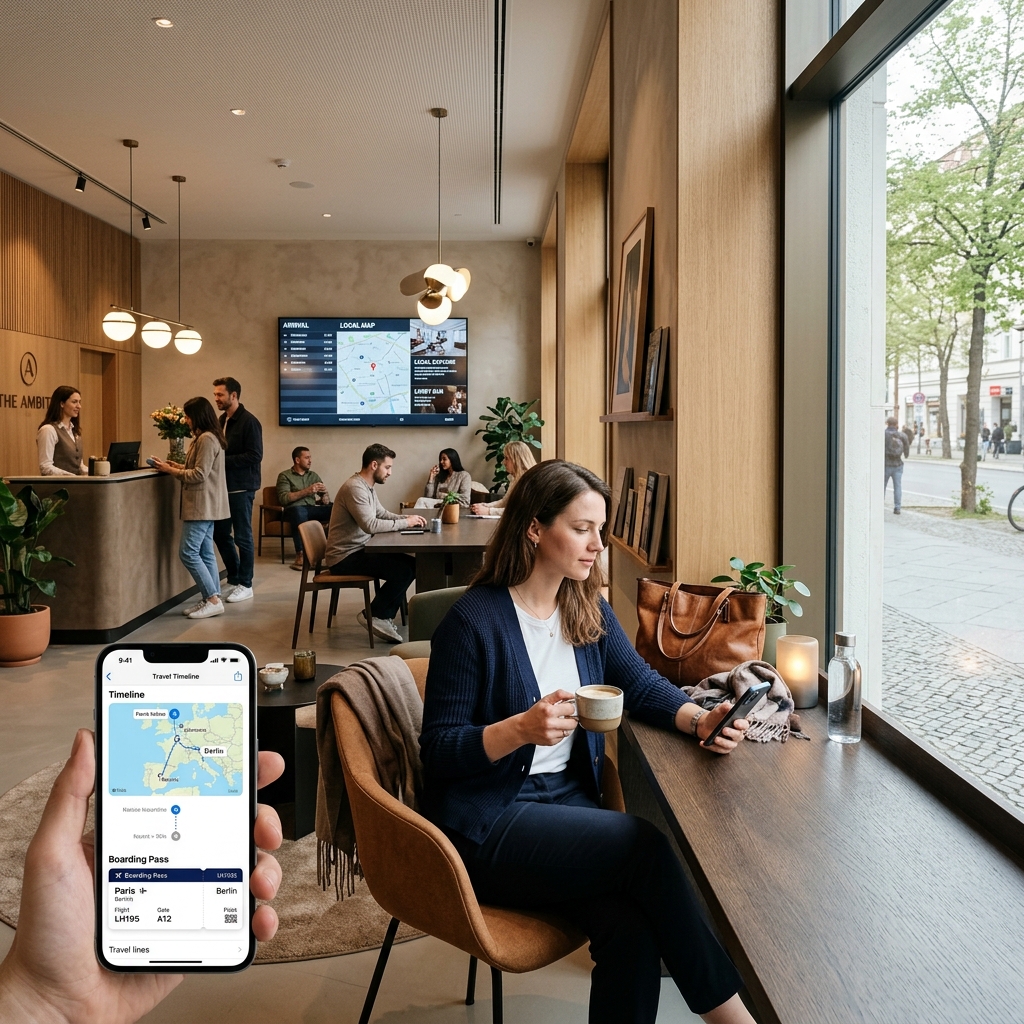
Most hotels can describe what happens at check-in. Far fewer can describe what happens in the twelve touchpoints before a guest arrives, or the eight that follow after checkout. That gap is exactly what a digital guest journey map is designed to close.
Research from Guestara found that 73% of hotels still treat every guest interaction in isolation. Each department — reservations, front desk, F&B, housekeeping — manages its own relationship with the guest, with little visibility into what the guest experienced before or after their department's moment. The result is a fragmented experience that feels inconsistent, even when each individual touchpoint is managed well. This guide explains what a digital guest journey is, why mapping it matters for 3–5 star properties in Spain and Benelux, and how to build a practical map your team can actually use.
What Is the Digital Guest Journey?
The digital guest journey is the complete sequence of interactions a guest has with your property — from their first digital encounter with your brand to the last message they receive after checkout. 'Digital' refers both to the channels through which these interactions occur (search, email, mobile, social) and to the data layer that makes them trackable and improvable over time. It is not the same as the 'guest experience', which typically refers to the physical stay. The digital guest journey encompasses everything that surrounds that experience — the research, the booking, the anticipation, the in-stay communication, and the post-stay relationship. A typical hotel property manages 30 to 50 distinct touchpoints across this full arc.
The five core stages
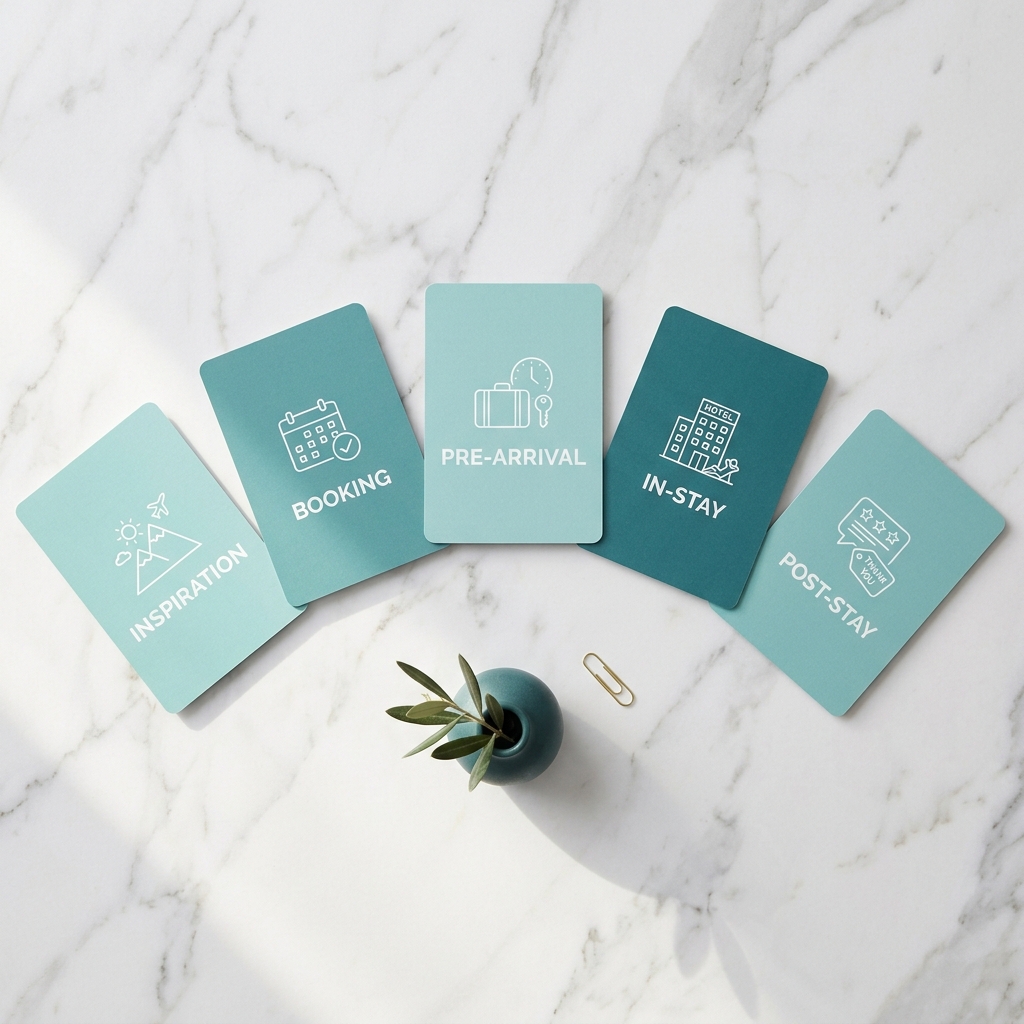
• Inspiration & Discovery — the guest encounters your brand for the first time (social media, OTA listing, Google search, word of mouth). • Consideration & Booking — the guest researches, compares, and commits. The booking engine, reviews, and your direct website are the critical touchpoints here. • Pre-Arrival — from booking confirmation to the moment the guest steps through the door. The highest-potential window for personalisation and upselling. • In-Stay — all interactions during the physical stay: check-in, service requests, dining, activities, and day-of communication. • Post-Stay — everything from checkout to the next booking. Reviews, loyalty, and return incentives live here.
Important framing: Modern guest journeys are non-linear. A guest may discover your hotel on Instagram, forget about it for three months, rediscover it on a metasearch engine, book directly, then share their experience on social media before they have even checked in. Your map should reflect this fluidity rather than imposing a rigid sequence.
Why Mapping the Digital Guest Journey Matters
Mapping is not a theoretical exercise. It is a diagnostic tool. When you map your guest's journey, you make visible the gaps, friction points, and missed opportunities that are otherwise invisible inside your day-to-day operations. Renascence CX research found that hotels addressing both emotional and practical guest needs in their journey design report 30% higher satisfaction scores than those addressing only practical needs. A further data point from the same research: cross-channel integration — ensuring that a guest's experience feels consistent whether they are on your website, receiving an email, or standing at the front desk — can increase overall satisfaction by up to 60%.
How to Map the Digital Guest Journey for Your Hotel: A Step-by-Step Framework
You do not need specialist software or a consultant to produce a useful journey map. A working version can be built in a half-day workshop with your front desk manager, a reservations team member, and whoever manages your digital communications. **Step 1: Define your guest persona** A journey map is only as useful as the guest it represents. Before mapping touchpoints, define one or two primary guest personas for your property. These should be based on your actual booking data — not aspirational profiles. **Step 2: List every touchpoint across all five stages** Work through each stage and list every point at which the guest interacts with your brand — or could interact with it. **Step 3: Map the guest mindset at each stage** Alongside each touchpoint, note how the guest is likely feeling. Matching your communication tone and content to the emotional state of the guest at each stage is what separates guest experience management from generic hospitality operations. **Step 4: Assign a digital channel to each touchpoint** For each touchpoint, identify the channel through which it is — or should be — delivered.
The Role of Digital Wallet Passes in the Modern Guest Journey
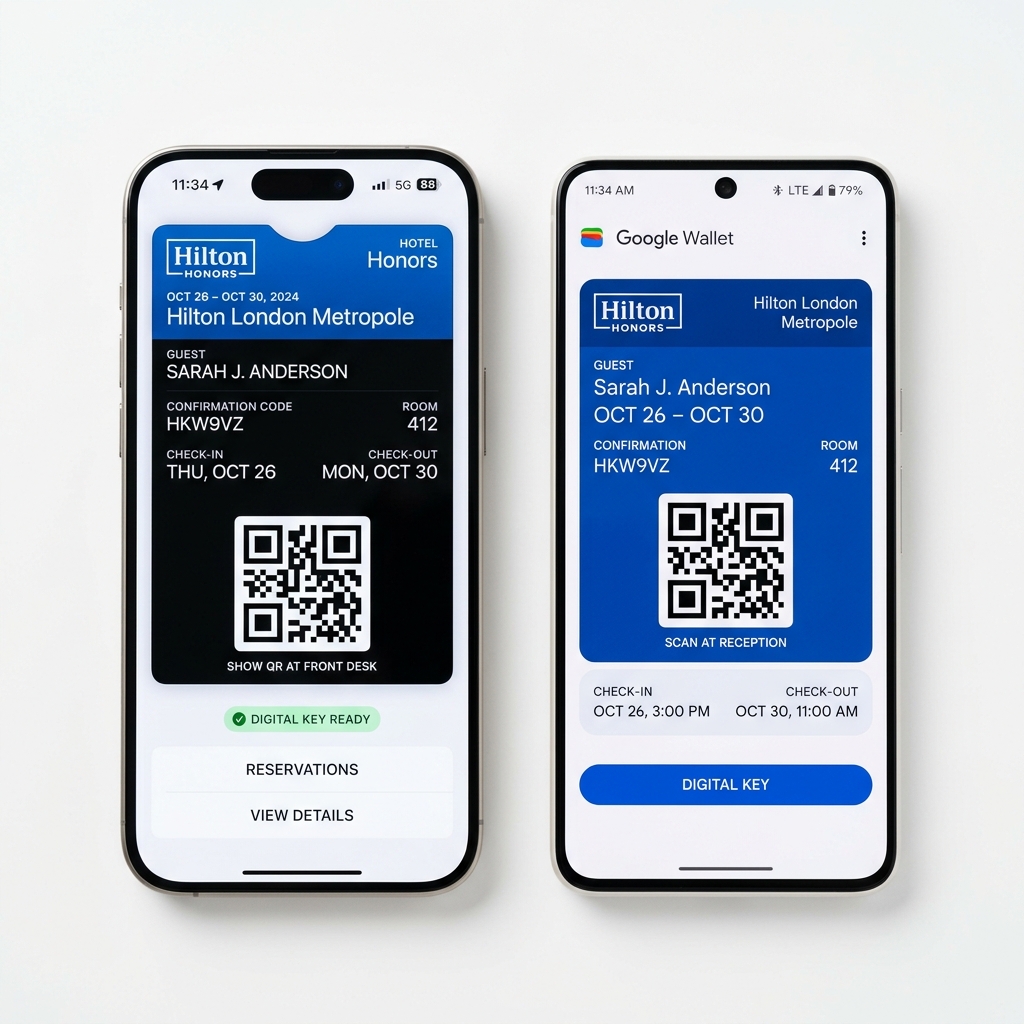
Most discussions of the digital guest journey assume a multi-channel architecture: email for pre-arrival, app for in-stay, email again for post-stay. This model works reasonably well for large hotel groups with the budget to build and maintain a proprietary app. For independent and boutique properties, it creates fragmentation. Digital wallet passes (Apple Wallet and Google Wallet) offer a different model. Rather than asking guests to download an app, register an account, or check an email at the right moment, the pass lives on the device they already have — in the same wallet they use for boarding passes and payment cards. It is persistent, updateable, and capable of pushing notifications without requiring an app.
tiketo in the journey map: A digital pass delivered via tiketo sits across multiple stages of the journey simultaneously. The same pass object that delivers a booking confirmation can update with check-in details on arrival day, push a spa offer mid-stay, and convert into a loyalty pass at checkout.
A Practical Example: Mapping the Journey for a 4-Star City Hotel
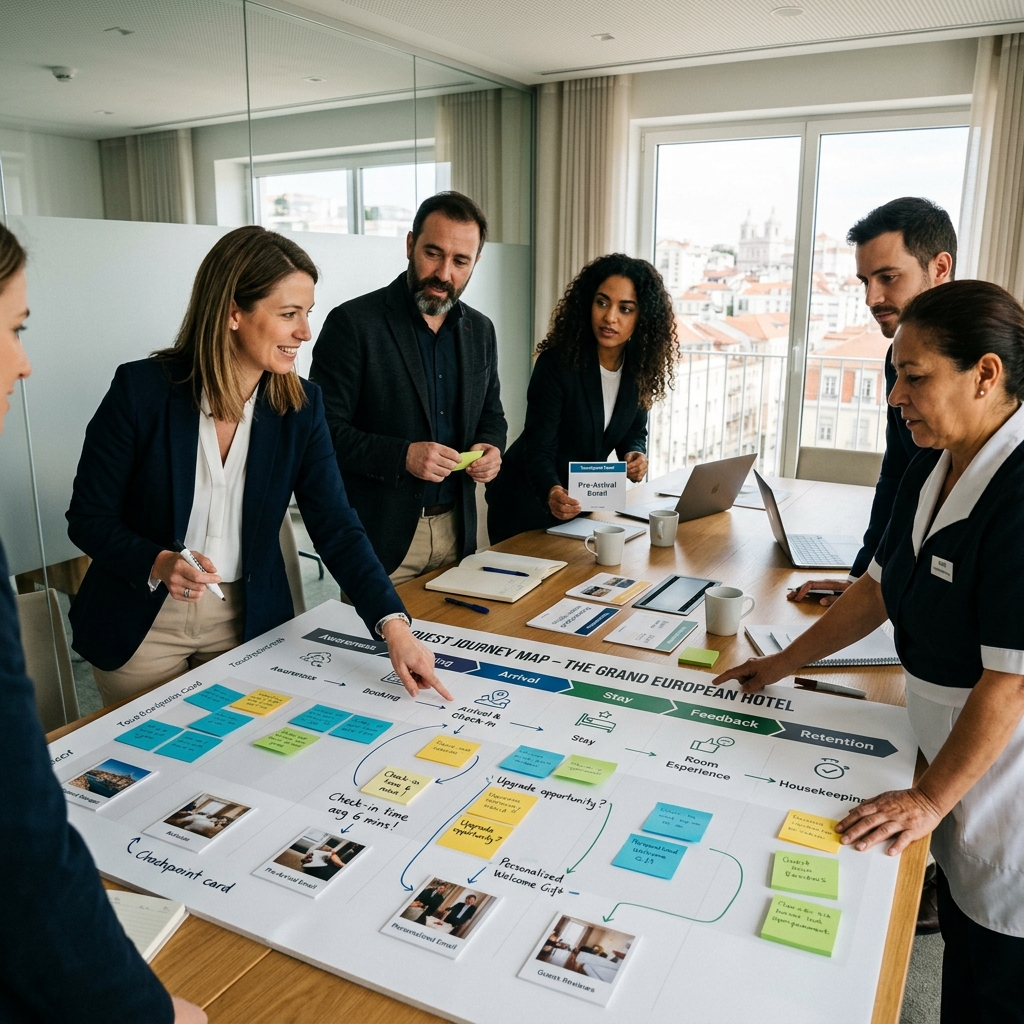
Consider a 4-star business hotel in Brussels with a mix of corporate and leisure guests. After mapping their journey, the team identified priority friction points (like lack of pre-arrival communication and ignored post-stay emails) and priority opportunities (delivering a digital pass at booking, in-stay push notifications, and lock-screen loyalty). The result was a digital guest journey with a consistent communication thread from booking to the next reservation — built on a single channel the guest already had on their device, requiring no new app and no login.
Closing Insight
A digital guest journey map is the single most useful tool a hotel can build for improving guest experience at scale. It makes visible the gaps that exist between your best intentions as a hotelier and what your guests actually experience. Want to see how tiketo fits into your digital guest journey? We work with hotels across Spain and Benelux to build a connected communication layer — from booking confirmation to post-stay loyalty — using Apple Wallet and Google Wallet passes.
Frequently Asked Questions
Q: What is a digital guest journey in hospitality?
A: The digital guest journey refers to the complete sequence of digital interactions between a guest and a hotel property — from first brand encounter through to post-stay communication.
Q: How many touchpoints does a typical hotel guest journey have?
A: Research suggests a typical hotel guest journey involves between 30 and 50 distinct touchpoints across digital and physical channels.
Q: What is a hotel customer journey map and how do you create one?
A: A hotel customer journey map is a visual or structured representation of all the stages and touchpoints a guest passes through. To create one, define guest personas, list touchpoints across each stage, assign a communication channel, and identify friction points and opportunities.
Q: What digital channels should hotels use at each stage of the guest journey?
A: Email works well for pre-arrival and post-stay communication. Push notifications via digital wallet passes are most effective for in-stay and time-sensitive messages.
Q: Do small or independent hotels need to map the guest journey?
A: Yes — and arguably more so than large chains. Their competitive advantage is the quality of the guest experience, which means understanding and optimising every touchpoint in the journey.
More from the tiketo Blog
How to Build a Hotel Loyalty Program Without a Big Tech Budget
Independent hotels don't need enterprise software to run a loyalty programme. Here's a practical, right-sized framework — built on a wallet pass.
How Mobile Wallet Passes Increase Direct Bookings for Hotels
OTAs take 15–30% per booking. Here's how mobile wallet passes shift guests to direct — and keep them there. A practical guide for independent hotels.
Mobile Check-In, Room Keys & Loyalty in One Pass: Is It Possible?
Can one digital hotel pass handle check-in, room key access and loyalty? Here's the honest answer — what's possible today, what needs hardware, and how to start.
Google Wallet Hotel Passes: The Complete Hospitality Guide
Everything hotel teams need to know about Google Wallet passes — pass types, push notifications, geo-triggers & real results. Powered by tiketo.
Apple Wallet for Hotels: How to Engage Guests Without an App
Apple Wallet is on every iPhone. Yet most hotels use it for one thing: a room door key. The pass — Apple's most powerful hospitality capability — is going almost entirely unused. Here's the full picture.
Push Notifications vs. Email: Which Works Better for Hotel Guest Communication?
If you manage guest communications at a hotel, there is a good chance you are making channel decisions based on email open rate data that is significantly inflated.
How to Personalise the Hotel Guest Experience at Scale
71% of hotel brands say personalisation is a priority, but only 15% believe they are doing it effectively. Discover a practical framework for bridging the execution gap without a full CRM overhaul.
5 Hospitality Trends Redefining the Guest Experience in 2026
From AI-powered bookings to digital wallet loyalty, discover the 5 data-backed trends redefining the guest experience in 2026 — and what they mean for your property.
How La Bottega Turns Guests Into Regulars.
Like many successful restaurants, La Bottega faced a familiar challenge: guests loved the experience, but paper loyalty cards weren't enough.
Why Guests Don't Download Hotel Apps — And What to Do Instead
Over 70% of guests drop off before completing hotel app registration. Here's why — and the no-download alternatives that actually work.
Loyalty Programs for Boutique Hotels: What Actually Works
Most boutique hotels copy chain loyalty mechanics and wonder why it fails. Here's what actually works — and why your advantage is emotional, not transactional.
The Friction of Prestige: Why Elite Golf Resorts Are Replacing Plastic Cards with Native Device Infrastructure
Traditional golf operators equate plastic cards with prestige. Discover why top-tier clubs are transitioning to native smartphone wallets to capture lost secondary revenue.