Apple Wallet for Hotels: How to Engage Guests Without an App
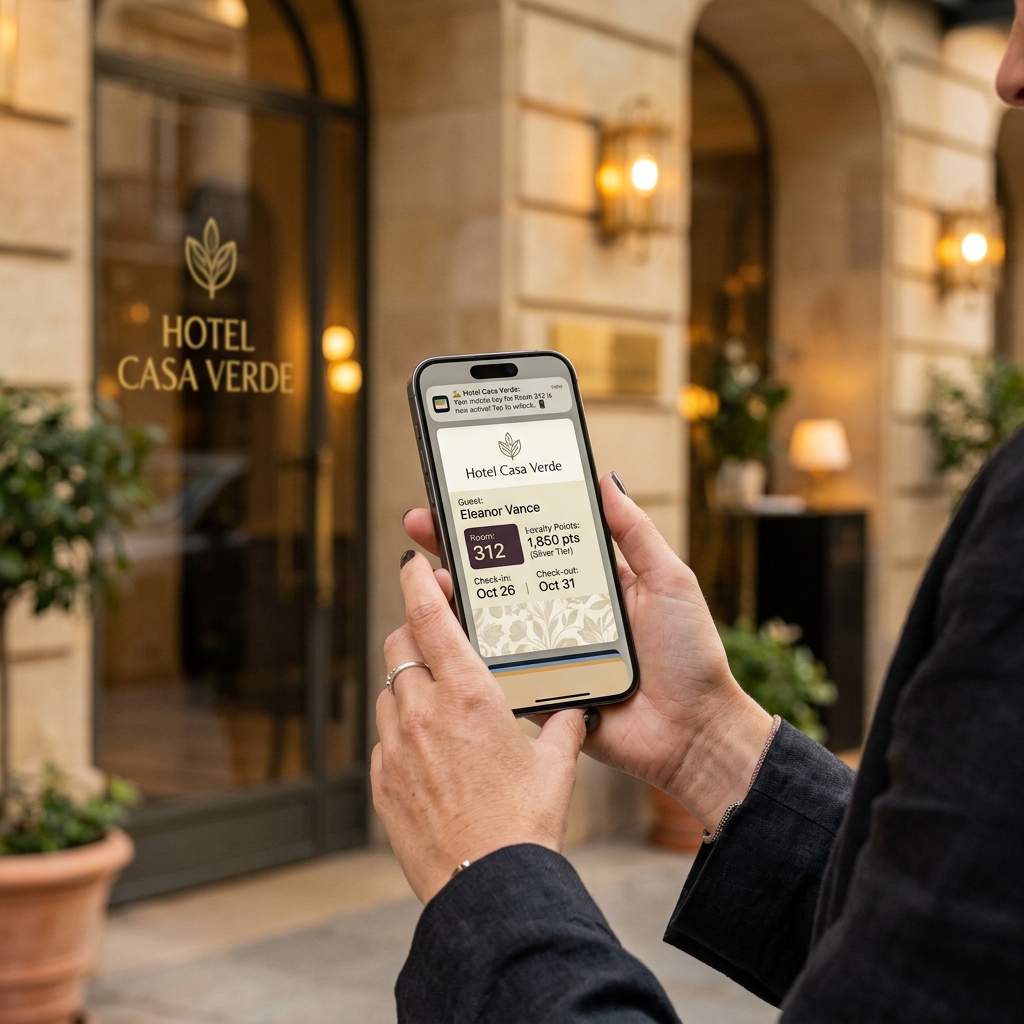
Apple Wallet is on every iPhone. Yet most hotels use it for one thing: a room door key. The pass — Apple's most powerful hospitality capability — is going almost entirely unused. Here's the full picture.
Apple Wallet is on the phone of a significant proportion of your arriving guests. The question is not whether Apple Wallet is relevant to hospitality. The question is why so few independent and boutique hotels are using it for anything beyond a room door key. Most hotels that engage with Apple Wallet at all do so through one narrow lens: digital room keys delivered via a brand app. This approach requires NFC-enabled door hardware, a maintained hotel app, and a guest willing to download it — a combination that works for international chains with multi-million euro technology budgets but is functionally out of reach for the majority of independent 3–5 star properties in Europe. What most hotel teams do not know is that the pass — Apple Wallet's core object type — is a completely separate capability from both Apple Pay (payments) and digital door keys. A hotel pass can be created, delivered, updated, and used to send push notifications to guests' lock screens without any room hardware integration, without a hotel app, and without a development team.
Apple Wallet, Apple Pay, and Hotel Passes: Understanding the Difference
There are three distinct Apple Wallet capabilities that are regularly conflated in hospitality discussions. **Apple Pay — the payment layer** Apple Pay is a contactless payment method. Guests store their payment card in Apple Wallet and authenticate transactions via Face ID or Touch ID. For hotels, Apple Pay enables frictionless in-property spend — F&B, spa, room service — and can reduce checkout abandonment in direct booking flows. It is valuable, but it is a payment tool, not a guest engagement channel. **Digital room keys — the access layer** Digital room keys allow guests to unlock their room using their iPhone or Apple Watch via NFC. This requires specific lock hardware, integration between the hotel's PMS and the key system, and typically a hotel app through which the key is initially issued. Hyatt was the first hotel brand to launch this capability in Apple Wallet in December 2021. It remains primarily a large-chain or luxury segment feature due to hardware and integration requirements. **Hotel passes — the engagement layer** Hotel passes are the capability that most independent hotels are missing. A pass is a digital card — similar to a boarding pass or loyalty card — that sits in Apple Wallet, can be branded, updated in real time, and used to send push notifications to the guest's lock screen. It requires no room hardware, no hotel app, and no developer team to build from scratch.
Key distinction: Apple Pay and digital room keys require hardware integration and/or a hotel app. Hotel passes do not. A pass can be created and delivered to any iPhone guest from a booking confirmation email — no infrastructure change required. This is the entry point for independent hotels.
What a Hotel Pass Can Actually Do: A Full Capability Map
A hotel pass is not a static digital business card. It is a dynamic object that evolves across the guest journey: • **Booking confirmation delivery** — Sends branded pass at confirmation email. One-tap 'Add to Wallet'; pass appears alongside boarding passes. • **Real-time pass updates** — Hotel pushes updated content remotely (room number, check-in status, offers). Pass refreshes automatically. • **Push notifications** — Time-stamped messages sent to lock screen at any journey stage. Tapping opens the pass. • **Geo-triggered notifications** — Alert fires when guest's device is near a defined location (spa, bar, pool). Contextual offer at the moment the guest is physically nearby. • **Loyalty points display** — Points balance shown on pass face, live and without logging in. • **Post-stay loyalty pass** — Pass converts from 'stay' format to 'loyalty' format at checkout. Persistent loyalty card receives return incentive push 7–10 days later.
Why 'No App Required' Is a Genuine Competitive Advantage
The hotel app problem is well documented. Research from PAR Engagement and Punchh found that only 25–30% of guests who begin downloading a brand app complete registration — with over 70% dropping off at the mandatory login stage. For a guest arriving for a two-night leisure stay at a boutique hotel in Valencia or Bruges, the prospect of downloading an unfamiliar app, creating an account, and completing a verification step is not a frictionless experience. The same research found that Apple Wallet passes actually accelerate app adoption rather than replacing it: Apple's own data indicates that 30% of guests who add a wallet pass subsequently download the brand's full app — because the pass delivered value first, before asking for commitment. For independent hotels, the practical implication is direct. A pass deployed via tiketo at booking confirmation reaches 100% of iPhone-carrying guests with a single tap. No login. No account. No download barrier.
European context: iOS market share in Europe is growing at a CAGR of 9.1% through 2033, driven by premium device positioning among exactly the affluent urban traveller segment that 3–5 star hotels depend on. In the UK, 64% of consumers already use Apple Pay for in-person transactions. Adoption across Spain, the Netherlands, and Belgium is strong and accelerating.
How Apple Wallet Passes Work Across the Guest Journey
**At booking confirmation** — The pass is delivered in the booking confirmation email. The guest taps 'Add to Apple Wallet'. The pass displays the hotel name, booking reference, arrival date, and room type. **In the pre-arrival window** — The hotel can push relevant updates to the pass: an upsell offer (room upgrade, early check-in, spa booking), a local recommendation, or a practical note about parking. **On arrival day** — The pass updates automatically to show the room number and check-in instructions once the room is ready. The guest receives a push notification: 'Your room is ready. Room 312, 3rd floor.' No front desk queue. **During the stay** — Push notifications can be used for time-specific in-stay offers. Geo-triggered notifications fire when the guest is near relevant hotel facilities. **At checkout and post-stay** — Rather than deleting the pass, it converts to a loyalty or return-visit format at checkout. A push notification fires 7–10 days post-checkout with the return offer still live on their lock screen.
Real-world example: A 4-star hotel in Seville implemented a tiketo pass workflow across its full guest journey. Pass adoption among iPhone-carrying guests exceeded 60% within the first quarter of operation, with the late-checkout push notification generating the highest single conversion rate of any guest communication the hotel had previously run.
Implementation: What It Takes to Get Started
**What a hotel needs:** 1. A pass management platform (tiketo) that handles pass creation, branding, delivery, updates, and notification scheduling. 2. A booking confirmation email with the 'Add to Apple Wallet' button — added via a template update in the hotel's existing email system. 3. Basic booking data fields — guest name, arrival date, departure date, room type — to populate the pass. 4. A defined notification calendar — which messages to send, at which journey stages. **What a hotel does NOT need:** • A hotel app — passes work directly in Apple Wallet, pre-installed on every iPhone. • NFC door hardware — required for digital room keys but not for engagement passes. • A developer team — pass platforms handle the technical infrastructure. • A large technology budget — pass platforms for independent hotels are priced for the segment. Implementation timelines for a standard independent hotel integration via tiketo typically run four to six weeks from onboarding to live guest deployment.
Closing Insight
Apple Wallet is already on the phone of a significant proportion of your arriving guests. The question is not whether to engage with this channel — it is how to deploy it beyond its most obvious use cases. For independent and boutique hotels in Europe, the hotel pass is the entry point: no app, no hardware, no development budget. A branded pass delivered at booking confirmation creates a persistent, updatable communication channel that works from the moment a guest confirms their reservation to the moment they consider their next stay. We work with independent and boutique hotels across Spain and Benelux to build and manage digital passes — designed, deployed, and sending push notifications within weeks. No app required.
Frequently Asked Questions
Q: What is an Apple Wallet hotel pass?
A: An Apple Wallet hotel pass is a digital card — similar to a boarding pass or loyalty card — that sits in the Apple Wallet app on a guest's iPhone. It displays branded hotel content and can send push notifications to the guest's lock screen. It requires no hotel app and no hardware investment, making it accessible to independent properties of any size.
Q: Do guests need to download anything to use a hotel pass?
A: No. Apple Wallet is pre-installed on every iPhone. When a guest receives their hotel pass in a booking confirmation email, they add it with a single tap on the 'Add to Apple Wallet' button. There is no separate download, no account creation, and no login required.
Q: Can Apple Wallet passes send push notifications to hotel guests?
A: Yes. Hotels can send push notifications through Apple Wallet passes that arrive on the guest's lock screen. These do not require the guest to have a specific app installed. Push notifications via wallet passes consistently achieve near-100% delivery rates and click-through rates significantly above email benchmarks.
Q: What is the difference between Apple Pay and Apple Wallet for hotels?
A: Apple Pay is a contactless payment method stored within Apple Wallet, used for making purchases. Hotel passes — stored in Apple Wallet — are relevant to guest engagement, communication, and loyalty throughout the full stay journey. Both capabilities are valuable; they serve different purposes.
Q: How does Apple Wallet integration work for independent hotels in Europe?
A: Independent hotels integrate Apple Wallet passes through a pass management platform such as tiketo. The platform connects to the hotel's PMS or booking system, generates a branded pass for each arriving guest, delivers it in the booking confirmation email, and manages updates and push notifications. No developer team, hotel app, or NFC hardware is required. GDPR-compliant opt-in consent is captured at the point the guest adds the pass to their wallet.
More from the tiketo Blog
How to Build a Hotel Loyalty Program Without a Big Tech Budget
Independent hotels don't need enterprise software to run a loyalty programme. Here's a practical, right-sized framework — built on a wallet pass.
How Mobile Wallet Passes Increase Direct Bookings for Hotels
OTAs take 15–30% per booking. Here's how mobile wallet passes shift guests to direct — and keep them there. A practical guide for independent hotels.
Mobile Check-In, Room Keys & Loyalty in One Pass: Is It Possible?
Can one digital hotel pass handle check-in, room key access and loyalty? Here's the honest answer — what's possible today, what needs hardware, and how to start.
Google Wallet Hotel Passes: The Complete Hospitality Guide
Everything hotel teams need to know about Google Wallet passes — pass types, push notifications, geo-triggers & real results. Powered by tiketo.
Push Notifications vs. Email: Which Works Better for Hotel Guest Communication?
If you manage guest communications at a hotel, there is a good chance you are making channel decisions based on email open rate data that is significantly inflated.
How to Personalise the Hotel Guest Experience at Scale
71% of hotel brands say personalisation is a priority, but only 15% believe they are doing it effectively. Discover a practical framework for bridging the execution gap without a full CRM overhaul.
5 Hospitality Trends Redefining the Guest Experience in 2026
From AI-powered bookings to digital wallet loyalty, discover the 5 data-backed trends redefining the guest experience in 2026 — and what they mean for your property.
How La Bottega Turns Guests Into Regulars.
Like many successful restaurants, La Bottega faced a familiar challenge: guests loved the experience, but paper loyalty cards weren't enough.
What Is a Digital Guest Journey and How to Map It for Your Hotel
Most hotels can describe what happens at check-in. Far fewer can describe what happens in the twelve touchpoints before a guest arrives, or the eight that follow after checkout. That gap is exactly what a digital guest journey map is designed to close.
Why Guests Don't Download Hotel Apps — And What to Do Instead
Over 70% of guests drop off before completing hotel app registration. Here's why — and the no-download alternatives that actually work.
Loyalty Programs for Boutique Hotels: What Actually Works
Most boutique hotels copy chain loyalty mechanics and wonder why it fails. Here's what actually works — and why your advantage is emotional, not transactional.
The Friction of Prestige: Why Elite Golf Resorts Are Replacing Plastic Cards with Native Device Infrastructure
Traditional golf operators equate plastic cards with prestige. Discover why top-tier clubs are transitioning to native smartphone wallets to capture lost secondary revenue.