Push Notifications vs. Email: Which Works Better for Hotel Guest Communication?
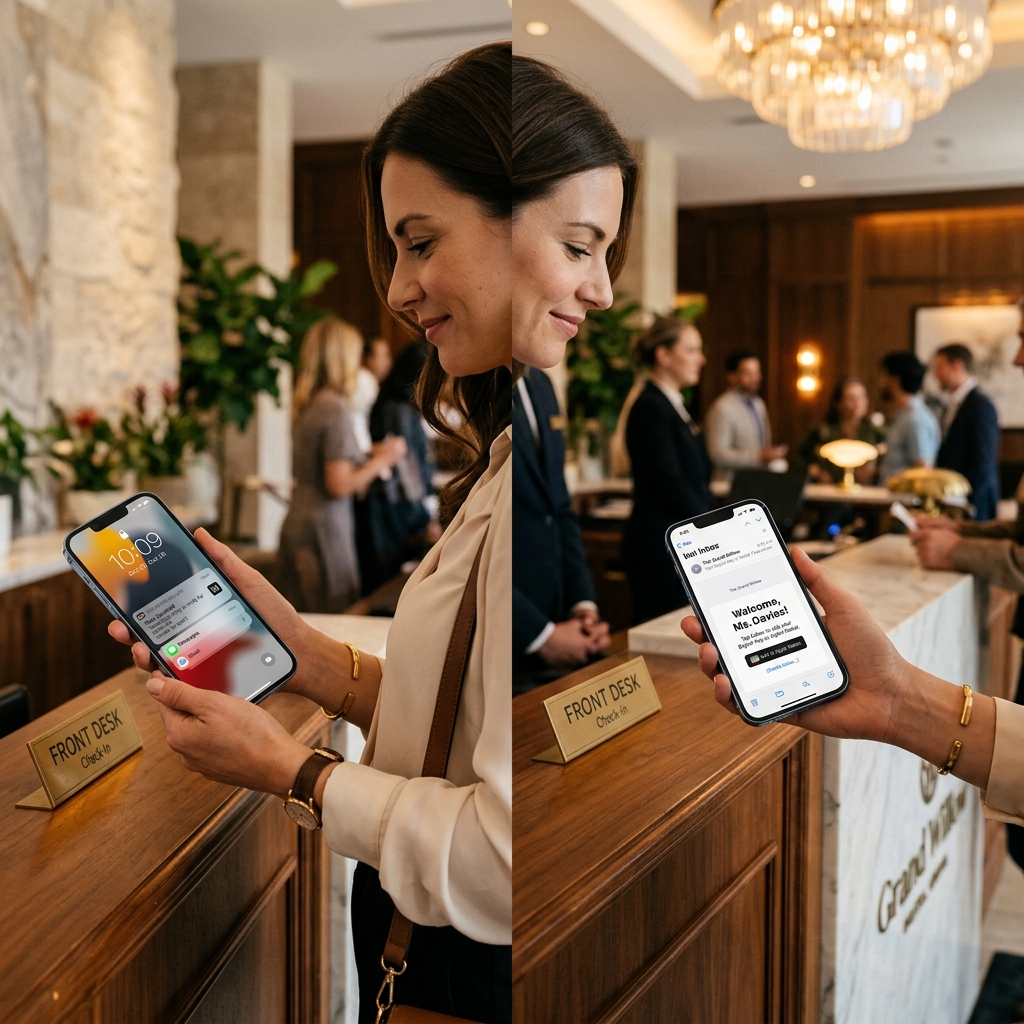
If you manage guest communications at a hotel, there is a good chance you are making channel decisions based on email open rate data that is significantly inflated.
If you manage guest communications at a hotel, there is a good chance you are making channel decisions based on email open rate data that is significantly inflated. Since Apple introduced Mail Privacy Protection in 2021, email opens have been automatically recorded for many recipients — whether or not they actually open the message. The result: cross-industry average open rates sit around 42–43%, while travel and hospitality emails in reality achieve closer to 22% genuine engagement, the lowest open rate of any industry tracked by MailerLite's 2025 benchmarks. This matters because it changes the channel comparison entirely. Email is not the dominant channel most hotels treat it as — at least not for time-sensitive, in-stay communication. Push notifications via digital wallet passes, SMS, and WhatsApp each outperform email in reach, response rate, and immediacy, when used at the right moment in the guest journey. This post works through each major hotel communication channel, gives you the data, and ends with a practical framework for matching channel to journey stage — so your guest communications actually reach the guests you're trying to engage.
The Email Open Rate Problem Hotels Need to Understand
Email remains the most widely used channel in hotel guest communication. Booking confirmations, pre-arrival information, post-stay review requests — all are delivered almost universally by email. For many of these use cases, email is the right call: it handles longer-form content well, it is expected for formal transactional communication, and guests are generally receptive to pre-arrival emails when they are relevant and timely. The problem is not email itself. The problem is using email performance benchmarks to make decisions about in-stay and time-sensitive communication — and those benchmarks are currently misleading. **Why email metrics in hospitality are unreliable** Apple's Mail Privacy Protection, introduced in iOS 15 and now standard across Apple devices, loads email tracking pixels automatically — regardless of whether the recipient opens the message. This artificially inflates open rate figures for any hotel with a significant share of Apple device users, which in Europe typically means 40–60% of the guest base. The practical consequence: a hotel reporting a 38% email open rate may be seeing genuine engagement from as few as 15–20% of recipients. MailerLite's 2025 sector data, which strips out MPP-inflated figures, puts the travel and transportation sector open rate at 22.57% — the lowest of any measured industry. Hospitality email click-through rates average just 1.4%, also among the lowest tracked.
What this means for your strategy: If your hotel's email open rate looks healthy, it may be masking real engagement that is materially lower. Before using email as your primary in-stay communication channel, consider what percentage of your guest base uses Apple Mail — and adjust expectations accordingly.
A Data-Backed Comparison of Hotel Guest Communication Channels
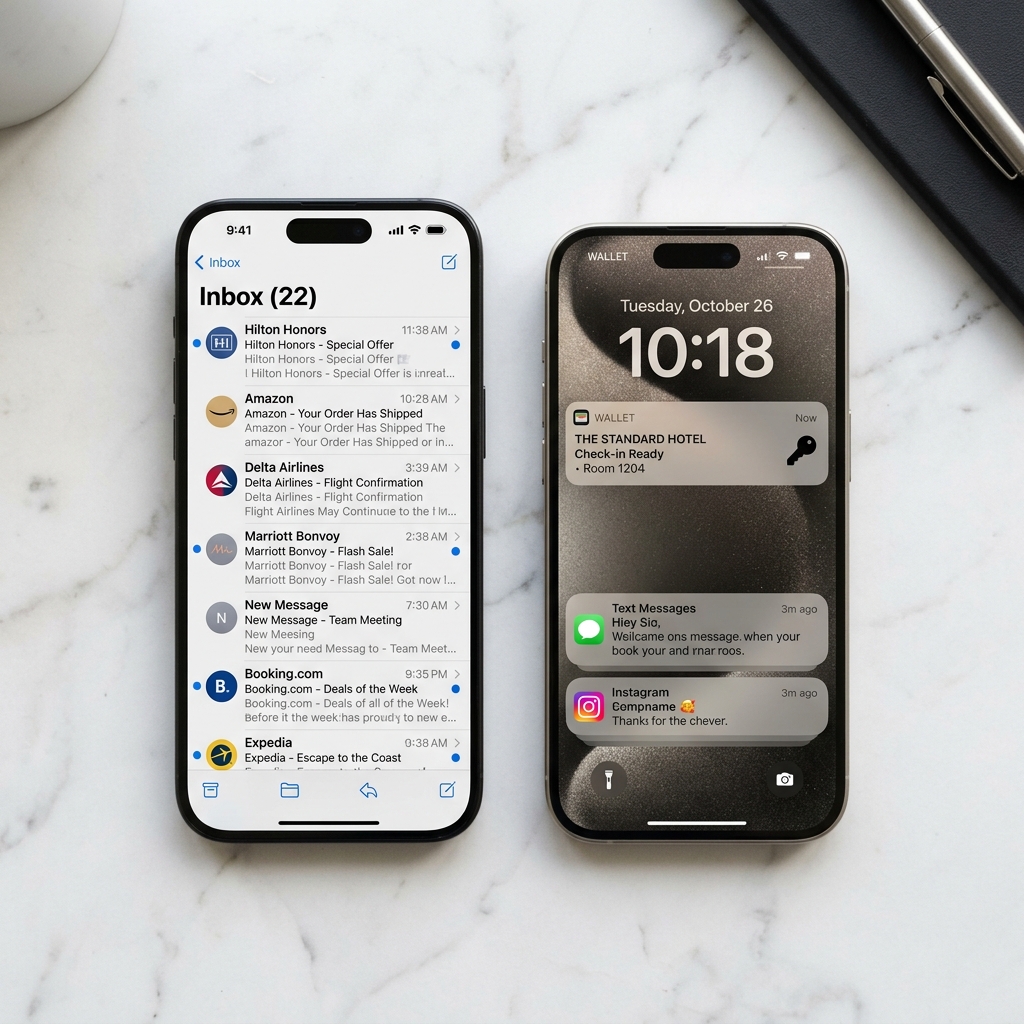
Rather than pitching push notifications against email in isolation, the more useful question is: what does each channel actually deliver, and where in the guest journey does it perform best? The table below summarises the five channels most relevant to European hotel operations:
• **Email** (22–45% open rate*): Best for pre-arrival, post-stay. Limited by inbox competition and inflated metrics. Requires opt-in. • **SMS / Text** (Up to 98% open rate): Best for urgent, time-sensitive alerts. Perceived as intrusive; per-message cost. Requires opt-in. • **WhatsApp** (Up to 98% open rate): Best for real-time service, dialogue. Not all EU guests use it; cost model. Opt-in required; WhatsApp Business API. • **Wallet Push** (Near-100% delivery): Best for in-stay, trigger-based upsells. Requires pass adoption at booking. GDPR-compliant opt-in at pass add. • **App Push** (Varies): Best for loyalty programme members. Near-zero independent hotel install rates. In-app consent required. *Email open rates: cross-industry average inflated by Apple MPP auto-opens. Travel & hospitality sector genuine open rate is closer to 22.57% (MailerLite 2025).
What Push Notifications via Wallet Passes Actually Deliver
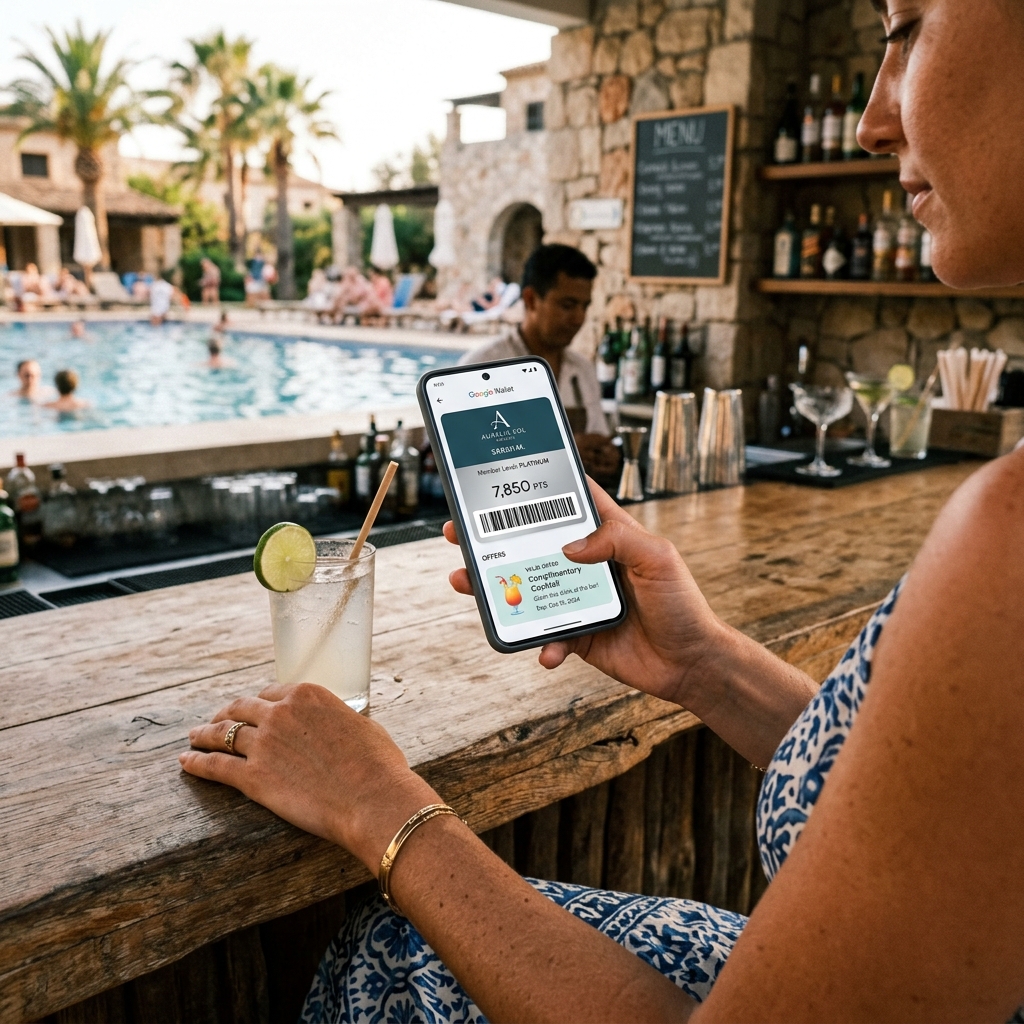
The term 'push notifications' covers several distinct technologies — app-based push, browser push, and wallet pass push — and they do not perform equally. App push notifications require the guest to have downloaded and opted in to a hotel app, which for independent and boutique properties is functionally irrelevant: app install rates for single-property hotels are close to zero. Wallet pass push notifications work differently. The guest already has Apple Wallet or Google Wallet on their device — it is the same app that houses their boarding passes and payment cards. Adding a hotel pass takes a single tap from the booking confirmation email. Once added, the pass can send push notifications that land on the lock screen, without any additional opt-in barrier and without competing with the email inbox. **The performance case for wallet push** • Near-100% delivery rate — notifications arrive on the lock screen regardless of inbox behaviour or email client settings. • 22% click-through rate — according to wallet pass benchmark data published by FanCircles in December 2025, wallet pass notifications outperform email, SMS, and social media by 5 to 20 times on CTR. • Geo-triggering capability — Google has extended geofence notifications to all standard wallet pass types, allowing hotels to trigger relevant notifications when a guest is near the spa, pool, or F&B outlet. • Persistent communication layer — unlike a push notification that is dismissed and forgotten, the pass remains on the device. The hotel's branding, the guest's room number, a current offer, and loyalty points balance are always one swipe away. • No app download required — the adoption barrier that kills hotel app strategies does not exist for wallet passes.
GDPR note: Under EU data protection law, wallet pass push notifications require that the guest has opted in by adding the pass to their device. This is an affirmative action — the guest taps 'Add to Wallet' — which provides a cleaner, more defensible consent record than most hotel email list opt-ins. For hotels operating in Spain and Benelux, this is a meaningful compliance advantage.
WhatsApp for Hotels: The European Context
WhatsApp is not a universally applicable hotel communication channel, but it is particularly well-suited to the European markets tiketo serves. Penetration is extremely high in Spain and the Benelux countries — WhatsApp is the primary messaging platform for personal communication in both markets. Guests from these countries are more likely to prefer and respond to a WhatsApp message from a hotel than a guest from North America, where SMS is the equivalent preference. Research cited by Straiv in 2025 puts WhatsApp open rates at up to 98%, with messages five times more likely to be opened than email. Unlike SMS, WhatsApp supports rich formatting, images, and interactive buttons — useful for presenting an upgrade offer or a spa booking link in a visual format. **Where WhatsApp fits — and where it does not** • Best fit: Real-time service communication during the stay. A guest asking about checkout time, requesting extra towels, or responding to an upsell offer — these are natural WhatsApp interactions. • Best fit: Check-in reminders and short pre-arrival messages for guests who have opted in. • Weaker fit: Formal transactional communication (booking confirmations, invoices). Guests expect these via email, and WhatsApp is a poor format for longer documents. • Weaker fit: Post-stay review requests. Email consistently outperforms WhatsApp for post-stay follow-up because it gives the guest space and a persistent link to act on in their own time. WhatsApp requires a WhatsApp Business API account and per-message costs for hotel-initiated conversations. It is most cost-effective for properties with a high proportion of European leisure guests, where uptake is likely to be strong. For hotels with a predominantly business travel or North American guest mix, SMS may be a more reliable fallback.
Which Channel to Use at Each Stage of the Guest Journey
The answer to the 'push notifications vs email' question is not one or the other — it is a sequenced multi-channel strategy where each channel is used at the moment where it performs best. The table below provides a practical reference framework for 3–5 star hotels in Spain and Benelux: • **Booking Confirmation:** Email (Transactional confirmation) + Wallet pass delivery prompt • **Pre-Arrival (72 hrs):** Email (Upsell offer + practical arrival info) + Wallet push notification • **Arrival Day:** Wallet push (Room ready alert) + SMS (if no pass) • **In-Stay (Day 1):** Wallet push (Welcome offer) + WhatsApp (opted-in real-time service) • **In-Stay (Mid-stay):** Wallet push (Geo-triggered upsell) + WhatsApp (service requests) • **Departure Eve:** Wallet push (Late checkout offer) + Email (checkout instructions) • **Post-Stay (24 hrs):** Email (Review request) • **Post-Stay (7–10 days):** Wallet push (Return incentive) + Email (loyalty reminder) **A few principles underpin this framework:** Email owns the formal bookends of the journey — confirmation and post-stay. These are the moments where guests expect a more considered, longer-form communication. Wallet push owns the in-stay and time-sensitive moments. The lock screen is where guests are when they are at the hotel, and the pass is the most frictionless way to reach them there. WhatsApp works as a real-time service layer for opted-in European guests, and as a secondary push channel at moments of high engagement.
tiketo in this framework: tiketo handles the wallet pass layer across the full journey — delivery at booking confirmation, real-time updates on arrival day, push notification scheduling for in-stay and post-stay moments, and pass conversion to loyalty format at checkout. The pass integrates with existing PMS and email systems rather than replacing them, fitting into the multi-channel framework without adding operational complexity.
A Practical Example: Moving From Single-Channel to Multi-Channel Communication
A 3-star city hotel in Barcelona operated a single-channel communication strategy: every guest interaction from booking to post-stay was handled via email. Pre-arrival open rates looked strong at around 38%, but the hotel's marketing manager suspected the Apple MPP effect was masking real engagement — particularly among their predominantly Spanish and Dutch leisure guest base. After auditing their actual click-through rate (1.3%, below the already-low hospitality average of 1.4%) and their post-stay review request response rate (under 8%), they restructured their channel approach: 1. Booking confirmation email retained — with the addition of a wallet pass delivery link ('Add your stay to Apple / Google Wallet'). 2. Pre-arrival email retained for content-rich communication, sent 72 hours before arrival. 3. Arrival-day room ready alert moved to wallet pass push notification — removing the email entirely and using the lock screen instead. 4. In-stay communication moved to wallet push for time-sensitive offers, and WhatsApp for Spanish-speaking guests who had opted in. 5. Post-stay review request retained on email, timed to 24 hours post-checkout. 6. Return incentive moved to wallet pass push, timed to 10 days post-checkout — replacing an email sequence that was generating minimal conversion. The restructured approach produced a measurable increase in ancillary spend per stay (driven by in-stay wallet push offers) and a higher post-stay review volume, partly because the simplified single-link email request was less competitive with the other messages guests were receiving from the hotel.
Closing Insight
The push notifications vs email question has a clear answer once you look at the data honestly: email is the right channel for formal, longer-form communication at the start and end of the guest journey. Push notifications via wallet passes are the right channel for in-stay, time-sensitive communication where lock-screen visibility translates directly into action. WhatsApp fills the conversational, real-time service layer for European leisure guests. SMS handles urgent fallback communication. The hotels achieving strong ancillary revenue and high guest satisfaction scores from their communication programmes are not those using the most sophisticated tools — they are those matching the right channel to the right moment, with a clear framework guiding every message they send. Want to add the wallet push layer to your hotel's communication strategy? tiketo integrates with your existing PMS and email systems to deliver Apple Wallet and Google Wallet passes to guests from booking confirmation through to post-stay loyalty — with push notifications, geo-triggers, and real-time pass updates. No app required.
Frequently Asked Questions
Q: Are push notifications better than email for hotel communication?
A: Push notifications — particularly via digital wallet passes — outperform email for in-stay, time-sensitive, and upsell communication, where immediacy and lock-screen visibility drive engagement. Email outperforms push notifications for formal, longer-form communication.
Q: What is the average open rate for hotel emails?
A: Published cross-industry email open rates (42–43% in 2025) are significantly inflated by Apple Mail Privacy Protection. The genuine open rate for travel and transportation emails is closer to 22.57%, the lowest of any sector tracked by MailerLite's 2025 benchmark report.
Q: Should hotels use WhatsApp for guest communication?
A: WhatsApp is well-suited to real-time, conversational in-stay communication — particularly for European leisure guests in Spain and Benelux. It is less well-suited to formal transactional communication or post-stay review requests.
Q: Do wallet pass push notifications require a guest to download an app?
A: No. Apple Wallet and Google Wallet are pre-installed on virtually all iOS and Android devices respectively. A guest adds a hotel's digital pass with a single tap from a booking confirmation email — no separate app download required.
Q: How do GDPR rules apply to hotel push notifications in Europe?
A: Under GDPR, all marketing communication requires a clear opt-in. For wallet pass push notifications, the guest's affirmative action of adding the pass to their device constitutes a strong consent signal, provided the delivery process is transparent.
More from the tiketo Blog
How to Build a Hotel Loyalty Program Without a Big Tech Budget
Independent hotels don't need enterprise software to run a loyalty programme. Here's a practical, right-sized framework — built on a wallet pass.
How Mobile Wallet Passes Increase Direct Bookings for Hotels
OTAs take 15–30% per booking. Here's how mobile wallet passes shift guests to direct — and keep them there. A practical guide for independent hotels.
Mobile Check-In, Room Keys & Loyalty in One Pass: Is It Possible?
Can one digital hotel pass handle check-in, room key access and loyalty? Here's the honest answer — what's possible today, what needs hardware, and how to start.
Google Wallet Hotel Passes: The Complete Hospitality Guide
Everything hotel teams need to know about Google Wallet passes — pass types, push notifications, geo-triggers & real results. Powered by tiketo.
Apple Wallet for Hotels: How to Engage Guests Without an App
Apple Wallet is on every iPhone. Yet most hotels use it for one thing: a room door key. The pass — Apple's most powerful hospitality capability — is going almost entirely unused. Here's the full picture.
How to Personalise the Hotel Guest Experience at Scale
71% of hotel brands say personalisation is a priority, but only 15% believe they are doing it effectively. Discover a practical framework for bridging the execution gap without a full CRM overhaul.
5 Hospitality Trends Redefining the Guest Experience in 2026
From AI-powered bookings to digital wallet loyalty, discover the 5 data-backed trends redefining the guest experience in 2026 — and what they mean for your property.
How La Bottega Turns Guests Into Regulars.
Like many successful restaurants, La Bottega faced a familiar challenge: guests loved the experience, but paper loyalty cards weren't enough.
What Is a Digital Guest Journey and How to Map It for Your Hotel
Most hotels can describe what happens at check-in. Far fewer can describe what happens in the twelve touchpoints before a guest arrives, or the eight that follow after checkout. That gap is exactly what a digital guest journey map is designed to close.
Why Guests Don't Download Hotel Apps — And What to Do Instead
Over 70% of guests drop off before completing hotel app registration. Here's why — and the no-download alternatives that actually work.
Loyalty Programs for Boutique Hotels: What Actually Works
Most boutique hotels copy chain loyalty mechanics and wonder why it fails. Here's what actually works — and why your advantage is emotional, not transactional.
The Friction of Prestige: Why Elite Golf Resorts Are Replacing Plastic Cards with Native Device Infrastructure
Traditional golf operators equate plastic cards with prestige. Discover why top-tier clubs are transitioning to native smartphone wallets to capture lost secondary revenue.