Why Guests Don't Download Hotel Apps — And What to Do Instead
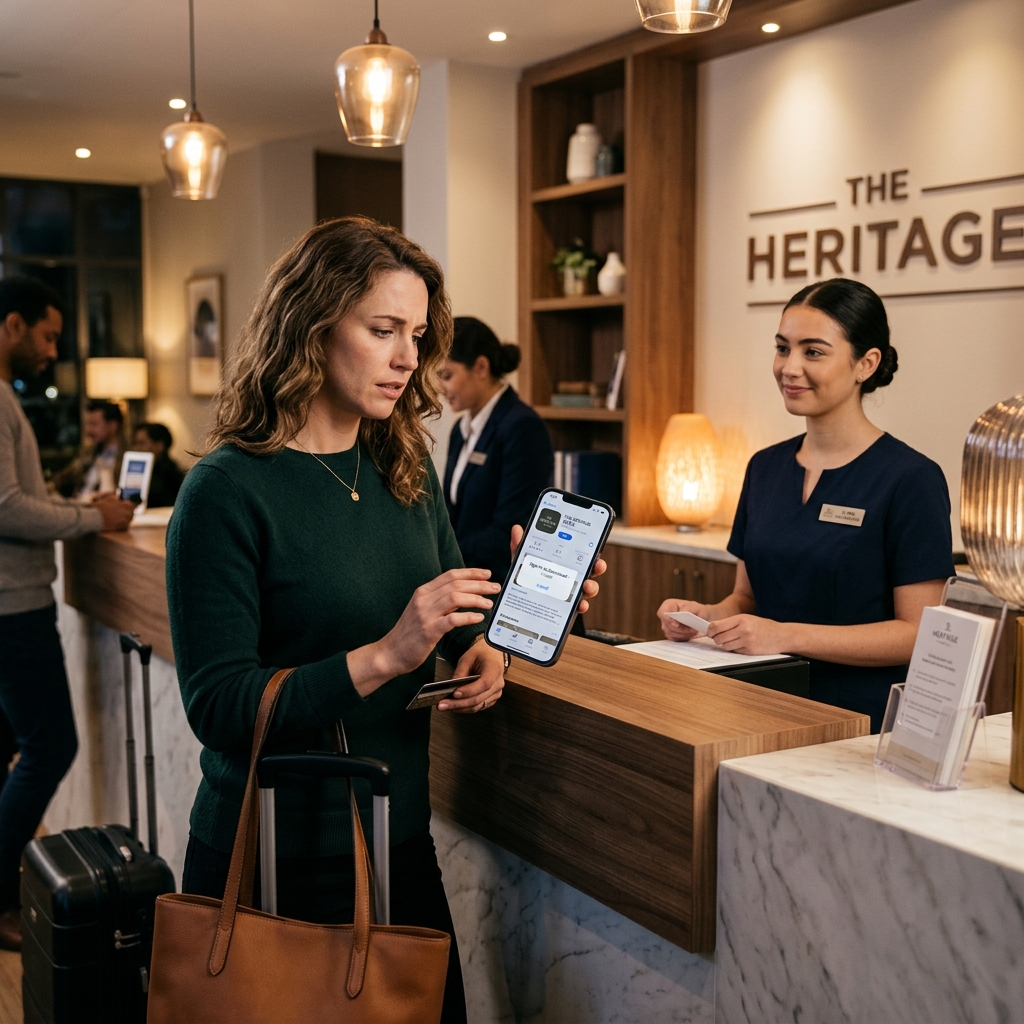
Over 70% of guests drop off before completing hotel app registration. Here's why — and the no-download alternatives that actually work.
If your hotel has invested in a branded app and the download numbers are disappointing, you are not alone and you are not doing anything wrong. The app adoption problem in independent hospitality is structural — it is not a marketing failure, a UX failure, or a feature failure. It is a value-exchange failure built into the nature of the channel itself. Guests downloading the Marriott Bonvoy or Hilton Honors app are making a rational decision: these brands have thousands of properties, active loyalty programmes, and a high probability of repeat use. The app investment — a few minutes, some storage space, a login — is justified by the likely return. The same calculation looks entirely different for a 4-star boutique hotel in Málaga or a 3-star business hotel in Rotterdam. The guest will stay once, possibly twice. The app offers modest convenience for a short window. The cost-benefit does not compute. This post diagnoses the five specific reasons guests don't download independent hotel apps — with data — and then maps each one to a practical no-download alternative that actually reaches guests where they are.
The Hotel App Adoption Problem: What the Data Actually Shows
The core issue with hotel apps is not that guests dislike technology. The same guest who won't download your hotel app spends hours per day in mobile apps. The issue is selective adoption — guests are extremely discriminating about which apps earn a place on their device, and a single-property hotel app rarely meets the threshold. The data illustrates the gap sharply. Android app retention rates across all categories average 22.6% at day 1 after download, 6.5% at day 7, and just 2.6% at day 30. iOS performs similarly: 25.6% on day 1, dropping to 4.3% at day 30. These are cross-category averages — travel apps, which represent a discretionary and infrequent use case, perform below these averages. A guest who downloads a hotel app for a two-night stay is statistically overwhelmingly likely to have deleted or ignored it within a week. More critically: over 70% of guests who begin the hotel app download process drop off before completing registration. The moment they encounter a mandatory account creation step — enter your email, choose a password, verify your address — the majority abandon. PAR Technology's research on app-based loyalty programmes puts completion rates at 25–30%. Three-quarters of interested guests walk away before the app ever delivers value.
The paradox: Guests want mobile-first hotel experiences. HotelTechReport's 2025 survey found that nearly half of all hotel guests prefer to check out via smartphone, and 43% of luxury guests expect to avoid the check-in queue entirely. The demand for digital is real. The appetite for downloading yet another single-use app to meet it is not.
Five Specific Reasons Guests Don't Download Hotel Apps
**1. The value-exchange calculation doesn't add up** Every app download requires a guest to give something: storage space, time, personal data, and a registration commitment. For an app they expect to use for 48–72 hours and never open again, the return does not justify the investment. This is not irrationality — it is entirely sensible consumer behaviour. The hotel app value proposition requires either high repeat-visit frequency (which chains have and independents don't) or a feature so immediately compelling that it overrides the friction of download and registration. Very few independent hotel apps offer that feature. **2. Mandatory registration creates a hard drop-off point** The single biggest conversion killer in hotel app adoption is the mandatory account creation step. When a guest reaches a screen requiring email, password, and verification before they can access any app functionality, over 70% stop and close. This is not laziness — research from Google found that 67% of users abandon apps that require too many steps to access information. The login gate is a structural barrier that app developers justify with loyalty data capture requirements, but which predictably kills adoption for transient guests. **3. Storage psychology and app fatigue** The average smartphone user has 80+ apps installed but actively uses fewer than 10 daily. Decisions about which apps to add are increasingly selective, and deletion of low-use apps is routine. A hotel app that will be used for one stay competes for storage and home screen real estate against apps the guest uses every day. The hotel app loses this competition in the majority of cases — not because it is poorly built, but because the frequency of use cannot justify permanent installation. **4. Performance anxiety around unfamiliar apps** Research from Google found that 70% of users who abandon an app do so because it is too slow. First-time users of an unfamiliar hotel app have no patience buffer — they have not chosen to invest in this relationship in the way they have with apps they use daily. A slow load, a confusing registration flow, or a feature that doesn't work as expected on the first attempt is enough to generate permanent abandonment. Hotel apps, built and maintained by small hospitality tech teams or white-label vendors, frequently cannot match the performance standard guests expect from apps they use daily. **5. The wrong moment to ask** Most hotel apps are promoted at check-in — the moment when a guest is standing at the front desk, carrying luggage, and thinking about getting to their room as quickly as possible. This is the worst possible moment to ask for a download. The guest is in task-completion mode, not engagement mode. By contrast, a digital wallet pass delivered at the moment of booking confirmation reaches a guest who is in anticipation mode — interested in the stay, open to additional information, and not yet in time pressure. Channel and timing matter as much as the feature set.
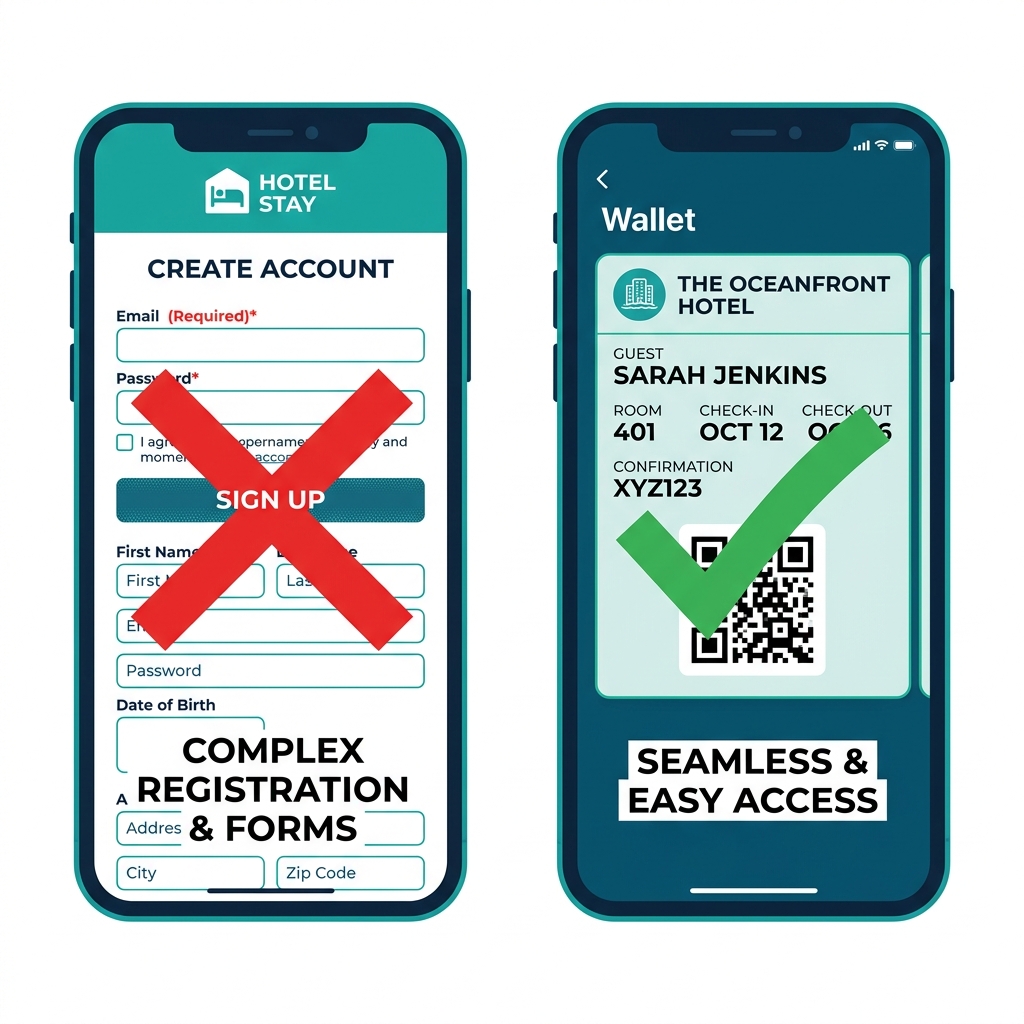
What to Do Instead: Five No-Download Alternatives for Hotels
The good news for independent hotels is that the features guests actually want from a hotel app — booking confirmation, check-in information, upsell offers, service requests, loyalty tracking — can all be delivered through channels that require no download. The table below summarises the main alternatives: • **Digital Wallet Pass:** Full journey engagement, push notifications, loyalty. No download required. Best fit for GDPR opt-in at booking confirmation. • **Progressive Web App (PWA):** Info delivery, service requests, menus. No download, but lacks persistent push notifications on iOS. • **WhatsApp / Messaging:** Real-time service, dialogue. Requires API and opt-in. Has per-message costs. • **Web-based check-in link:** Pre-arrival ID, payment, preference collection. Single-use, no persistence post-check-in. • **In-room tablet / QR:** In-stay F&B, service requests. Only works on-property.
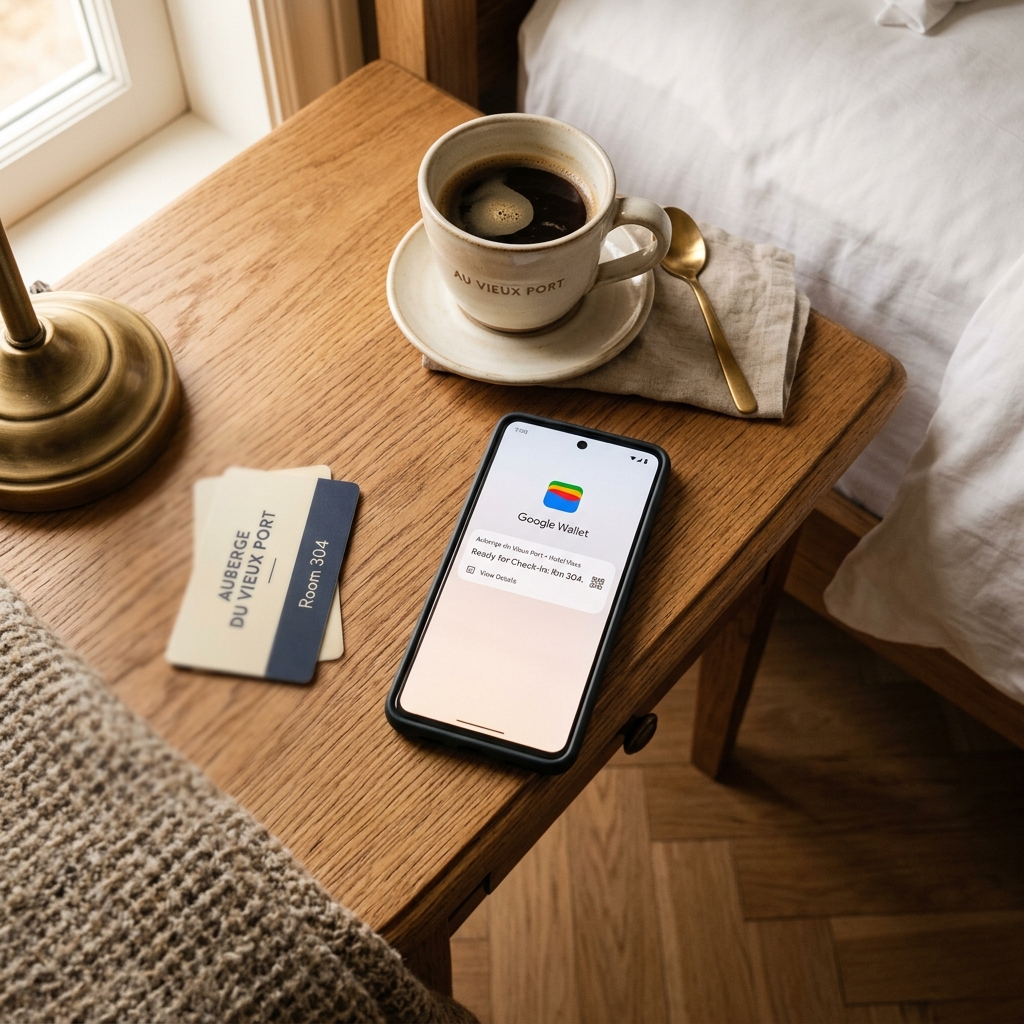
The Strongest Alternative: Digital Wallet Passes
Of the no-download alternatives available to independent hotels, digital wallet passes (Apple Wallet and Google Wallet) are the most capable and the most persistent. They are the only no-download channel that combines push notification capability, real-time updateable content, geo-triggering, loyalty display, and a persistent device presence — all without requiring the guest to take any action beyond tapping 'Add to Wallet' once. The adoption mechanics are fundamentally different from app adoption. The guest does not visit an app store. They do not create an account. They do not set a password. They tap a single button in their booking confirmation email. Apple Wallet and Google Wallet are pre-installed on every iPhone and Android device respectively — there is nothing to download because the wallet is already there. The hotel pass lives alongside the guest's boarding pass and bank cards, in the interface they already open multiple times a day. **What a wallet pass delivers that an app cannot replicate for independents** • Instant adoption — one tap from the booking confirmation email, no registration barrier. • Lock-screen presence — push notifications reach the guest without competing for inbox attention. • Real-time updates — room number, check-in status, offers, loyalty balance: all updated remotely without the guest taking any action. • Geo-triggered contextual notifications — available on both Google Wallet (Nearby Passes, extended to all pass types October 2025) and Apple Wallet. • Post-stay persistence — the pass converts to a loyalty format at checkout, maintaining the communication channel with no re-engagement required. • Trust transfer from existing platforms — the guest already trusts Apple Wallet and Google Wallet. Adding a hotel pass to a trusted platform is a lower-friction proposition than installing an unfamiliar app.
Important nuance: Wallet passes do not replace hotel apps for chains with active loyalty programmes and high repeat-visit frequencies. Marriott Bonvoy, Hilton Honors, and IHG One Rewards are correctly delivered via dedicated apps because the value-exchange calculation — frequent stays, points accumulation, global property access — justifies the download investment. For independent and boutique hotels where guests stay once or twice a year, the wallet pass is the correct tool. It delivers the same engagement capabilities with a fraction of the adoption friction.
How to Transition Away From an App-First Mobile Strategy
For hotels that have invested in a branded app but are seeing low adoption, the transition does not need to be abrupt. The practical steps are: **Step 1: Audit your current app adoption rate honestly.** Pull your app download numbers for the last 12 months and divide by total guest arrivals. If the adoption rate is below 15%, the app is not functioning as a meaningful guest communication channel. **Step 2: Identify which features guests actually use.** HotelTechReport's 2025 data shows the most-used hotel app features are: mobile check-in/check-out, messaging, and room service ordering. All three can be delivered without requiring app installation. **Step 3: Deploy a wallet pass programme at booking confirmation.** Implement a digital wallet pass via a platform such as tiketo, delivered in the booking confirmation email. Properties making this transition typically see pass adoption rates three to five times higher than their previous app adoption rates within the first 90 days. **Step 4: Redirect app maintenance budget to pass programme management.** Native app maintenance consumes ongoing budget with diminishing returns. Redirecting this budget to a wallet pass programme and optional PWA delivers higher guest reach at lower total cost of ownership. **Step 5: Keep the app if your loyalty data justifies it.** If your property has a genuine loyalty programme with a meaningful percentage of repeat guests (typically 20%+), a branded app may still be worth maintaining for this segment.

Closing Insight
The hotel app adoption problem is not going to be solved by building a better app or marketing an existing one more aggressively. It is structural — rooted in the economics of single-stay value exchange, the psychology of device storage, and the friction of mandatory registration. The hotels achieving strong mobile engagement rates are not doing so with apps. They are doing it through channels that meet guests on devices they already have, in interfaces they already trust, without asking for a commitment that most guests will not make. Want to see what a no-download mobile engagement strategy looks like for your hotel? tiketo builds and manages Apple Wallet and Google Wallet passes for independent hotels across Spain and Benelux — delivering the mobile engagement capabilities your guests actually want, without the download friction they won't accept.
Frequently Asked Questions
Q: Why don't hotel guests download hotel apps?
A: Five factors drive low hotel app adoption: the value-exchange calculation doesn't justify the download for a single stay; mandatory registration creates a 70%+ drop-off barrier; storage psychology and app fatigue make guests selective about new installs; performance expectations from unfamiliar apps are low-tolerance; and apps are typically promoted at the worst possible moment (check-in).
Q: What is the best alternative to a hotel mobile app?
A: For independent and boutique hotels, digital wallet passes (Apple Wallet and Google Wallet) are the strongest no-download alternative. They require no registration, no app store download, and no storage commitment — the guest adds the pass with a single tap from a booking confirmation email.
Q: Can hotels communicate with guests without an app?
A: Yes. Hotels can deliver the full range of guest communication — pre-arrival information, in-stay offers and service updates, push notifications, loyalty tracking, and post-stay engagement — through a combination of email, digital wallet passes, WhatsApp, and web-based check-in links.
Q: Do digital wallet passes work on both iPhone and Android?
A: Yes. Apple Wallet passes work on all iPhones and Apple Watch devices. Google Wallet passes work on all Android devices running Android 5.0 and higher. A pass management platform such as tiketo generates both pass formats simultaneously.
Q: Should independent hotels still have a mobile app?
A: For most independent and boutique hotels, a branded native app is not a worthwhile investment relative to the adoption rates it generates. The exception is hotels with a genuine, active loyalty programme and a repeat-guest rate above approximately 20%.
More from the tiketo Blog
How to Build a Hotel Loyalty Program Without a Big Tech Budget
Independent hotels don't need enterprise software to run a loyalty programme. Here's a practical, right-sized framework — built on a wallet pass.
How Mobile Wallet Passes Increase Direct Bookings for Hotels
OTAs take 15–30% per booking. Here's how mobile wallet passes shift guests to direct — and keep them there. A practical guide for independent hotels.
Mobile Check-In, Room Keys & Loyalty in One Pass: Is It Possible?
Can one digital hotel pass handle check-in, room key access and loyalty? Here's the honest answer — what's possible today, what needs hardware, and how to start.
Google Wallet Hotel Passes: The Complete Hospitality Guide
Everything hotel teams need to know about Google Wallet passes — pass types, push notifications, geo-triggers & real results. Powered by tiketo.
Apple Wallet for Hotels: How to Engage Guests Without an App
Apple Wallet is on every iPhone. Yet most hotels use it for one thing: a room door key. The pass — Apple's most powerful hospitality capability — is going almost entirely unused. Here's the full picture.
Push Notifications vs. Email: Which Works Better for Hotel Guest Communication?
If you manage guest communications at a hotel, there is a good chance you are making channel decisions based on email open rate data that is significantly inflated.
How to Personalise the Hotel Guest Experience at Scale
71% of hotel brands say personalisation is a priority, but only 15% believe they are doing it effectively. Discover a practical framework for bridging the execution gap without a full CRM overhaul.
5 Hospitality Trends Redefining the Guest Experience in 2026
From AI-powered bookings to digital wallet loyalty, discover the 5 data-backed trends redefining the guest experience in 2026 — and what they mean for your property.
How La Bottega Turns Guests Into Regulars.
Like many successful restaurants, La Bottega faced a familiar challenge: guests loved the experience, but paper loyalty cards weren't enough.
What Is a Digital Guest Journey and How to Map It for Your Hotel
Most hotels can describe what happens at check-in. Far fewer can describe what happens in the twelve touchpoints before a guest arrives, or the eight that follow after checkout. That gap is exactly what a digital guest journey map is designed to close.
Loyalty Programs for Boutique Hotels: What Actually Works
Most boutique hotels copy chain loyalty mechanics and wonder why it fails. Here's what actually works — and why your advantage is emotional, not transactional.
The Friction of Prestige: Why Elite Golf Resorts Are Replacing Plastic Cards with Native Device Infrastructure
Traditional golf operators equate plastic cards with prestige. Discover why top-tier clubs are transitioning to native smartphone wallets to capture lost secondary revenue.